If you've been looking for a way to expand your knowledge of film on a weekly basis, and you have a strong need to learn about the dominant artistic form of our age, but you still have no desire to shower, to shave your legs, or to even get dressed, then you've just found your perfect cinema university. Welcome, neophytes and class regulars all, to another edition of CRAVE Online's Free Film School, where I, Witney Seibold ND, your humble professor, will teach you all about the film details you didn't even know you were itching to learn. And I won't require that you get dressed, put out that cigarette, or turn down that music. Although you could probably be listening to something better.
Today's lesson is a history lesson that leads into another technical exercise. Next week, I promise it'll be something more fun. But today, I want to point out something very basic about moviegoing that people don't typically pay attention to: the shape of the screen itself.
If you were, like me, an avid collector of home videos (and I started well before the DVD revolution, amassing a sizable amount of VHS tapes, many of which I still own), then you are familiar with the passionate hunt of the words “widescreen edition.” That is, you looked for the tapes that would feature black bars at the top and the bottom of the screen, with the movie playing out on a stripe down the middle. You see, when VHS tapes first hit the market back in the mid-1980s, no one bothered to notice that TV screens weren't the same shape as most movie screens. TVs were still modeled after movie screens from the 1940s; that is to say, they were almost square. The jargon used to describe the shape of a screen is “Aspect Ratio,” a term all DVD collectors are now familiar with. Old TV screens were 1.33:1, or 1.33 inches across for every inch high. And while most flat-screen TVs you get these days are now rectangular, they still don't exactly match movie screens.

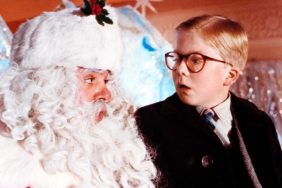
If you're watching a film made before 1953 on a widescreen TV, like 'Miracle on 34th Street' for example, then it had better damn well look like this (1.33:1 aspect ratio).
The idea of making screens rectangular began as early as 1927, with Abel Gance’s epic Napoleon, which, despite the available technology, essentially put two projectors next to each other, and ran them both at once, where characters would occasionally pass from one screen to the other. It was a rudimentary technique that was praised at the time, but was not widely adopted, as it proved too expensive.
Widescreen in earnest, though, began in 1953 with the release of a famed biblical epic called The Robe, with Richard Burton and Jean Simmons. In 1953, you see, the television set had become a household institution, and movie attendance had dropped off considerably. To combat the TV menace, Hollywood began adopting gimmicks to provide something at the movies that couldn't be acquired at home. This was about when 3-D started cropping up in earnest for the first time. Thanks to a recent fear that the internet is sapping people away from theaters, 3-D has made a return. I'm sure you've noticed. But the only “gimmick,” that managed to stay relevant, and indeed revolutionized filmmaking, was widescreen filmmaking, or CinemaScope as it was called.

If you're watching a 2.35:1 aspect ratio movie, like 'American Psycho,' then it had better look like this instead, because that's how the damned movie looks.
Now, to be sure, the idea of making films rectangular, so that they stretch all the way across your field of vision, is not a new concept. Back in 1926, a French photographer named Henri Chrétien had invented a special process he called Anamorphoscope which involved a special lens that would essentially “squish” the image being filmed so that it would look elongated, top to bottom, when played back on a regular projector. Only when another special lens was placed on a projector would the image be “righted,” and it would stretch horizontally across the wall. This process was considered too weird at the time, when all films were being shot without special lenses, and no movie theaters were equipped with them. But by 1953, the process had evolved enough that major studios felt they could throw huge amount of money at it, and it surprisingly caught on.
To this day, many of the films you see will be rectangular. A 2.35:1 aspect ratio. Some will even be 2.66:1. No one has managed to push the process further, yet, but perhaps that day will come. Many films, though, are also still shot in a 1.85:1 aspect ratio. Check out the DVDs you have around you, and you'll often find the aspect ratio printed on the package.

1953's 'The Robe' was the first widescreen movie. The difference was striking right off the bat, opening up a whole new world of cinematic storytelling. Unlike some other movie gimmicks. *COUGH-3D-I'M-LOOKING-AT-YOUCOUGH*